AI Video Generator - AI Photo
- 4.8
- Rating
- 500.00K
- Installs
- Free
- Price

 Analysis by App-foxy
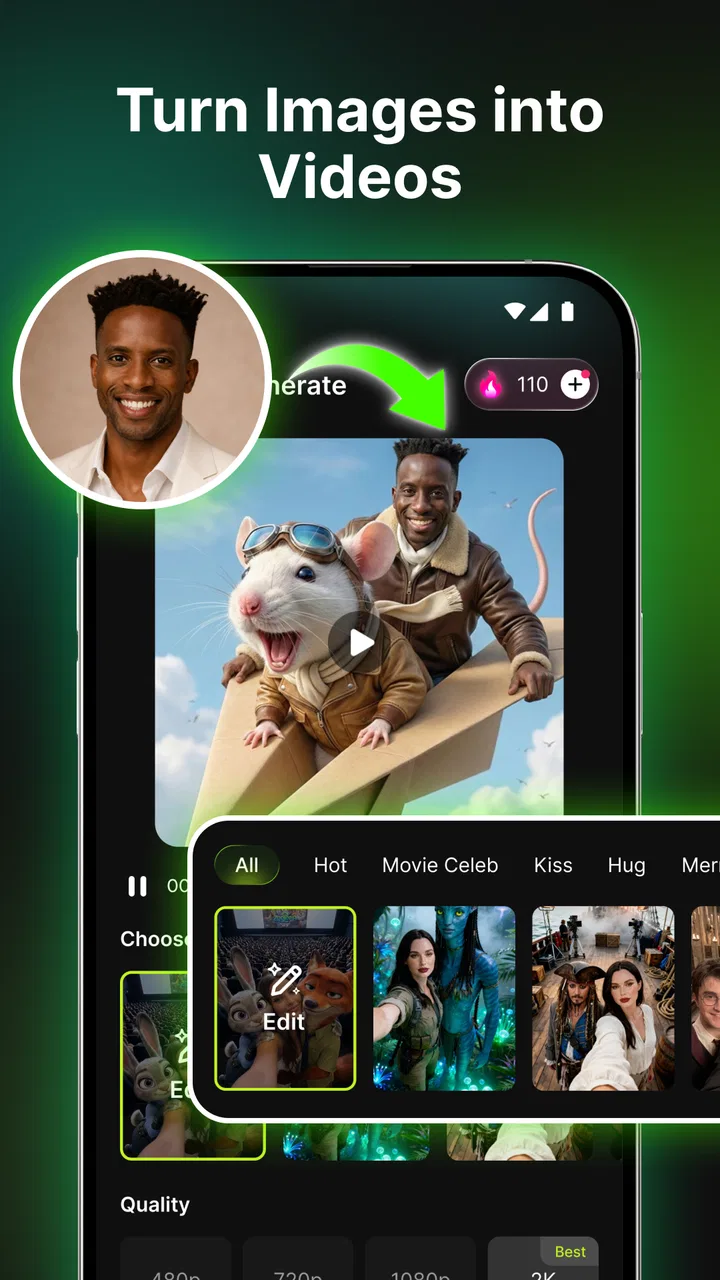
I approached AI Video Generator - AI Photo as a practical tool rather than a replacement for a full video editor. It sits in the video players and editors category, but its focus is much narrower and more interesting: turning written ideas or still images into short AI-assisted visual clips. In my experience, that makes it most useful when I want to explore a concept quickly, animate a photo, or create a starting point that I can refine elsewhere.
The app is developed by Kayle AI Solution and is available for free, with optional purchases ranging from $0.99 to $39.99 per item. It has an Everyone age rating, so the basic concept is easy to understand for a broad audience. The important question is not whether it can make a video with very little effort; it can. The better question is whether the result is good enough for the way you plan to use it.
How the current version feels in everyday use
The current version is 11, and the app has reached over 100K installs with a 4.7 average from around 2.5K ratings. Those figures suggest that it has found an audience among people who want a simple entry into AI video creation rather than a complicated production suite. I can understand that appeal. The first barrier to making a clip is often not editing skill but having a starting idea, and a text-to-video workflow removes much of that hesitation.
You May Also Like

 Blood Strike: 2.5 Anniversary
Blood Strike’s Loadouts Turn Every Drop Into a Tactical Gamble
A close look at Blood Strike’s custom loadouts: how fast access to signature weapons reshapes its battle royale rhythm, rewards preparation, and narrows the gap between fights.

 Pandora - Music & Podcasts
Pandora’s Music Is Easy to Start, but Harder to Recover
Pandora’s strength is its low-effort path from a seed to a station. Its weak spot is how much confidence it asks you to place in connection, setup, and quiet recovery.

 8 Ball Pool
 Is Built on Rivalries, Rematches, and Routine
A close look at the rivalries, rematches, shared routines, and unanswered safety questions that turn a quick pool match into a persistent mobile community.

 Samsung Music
’s Quiet Strength Is Playing What You Already Own
Its reach comes less from spectacle than from dependable access to a personal library. That simplicity is both the app’s strongest retention engine and its ceiling.

 AccuWeather: Weather Radar
AccuWeather Review: A Quick, Clear Forecast for Everyday Decisions
For everyday plans, the best forecast is the one you can understand quickly. AccuWeather makes rain timing, radar, and local conditions easy to act on, with a few trade-offs.

 Hill Climb Racing
Why Hill Climb Racing Still Turns Crashes Into One More Run
A tiny car, a bumpy hill and one more upgrade: Hill Climb Racing keeps resurfacing because its simple chaos makes every near-miss feel personal.
More From Our News Desk



I found the strongest use case to be visual experimentation. You can begin with a sentence describing a scene, or use an existing image as the foundation for movement. That is especially handy for social posts, mood boards, story concepts, birthday messages, profile visuals, and quick demonstrations. Instead of searching through stock footage or learning keyframes, I can describe the atmosphere I want and see whether the result gives me something worth developing.
The photo animation angle is also more practical than it may sound. A still image can feel flat in a presentation or social post, while a restrained motion effect can give it more presence. Family photographs, travel pictures, product images, illustrations, and character artwork all have different potential here. I would not treat the output as a guaranteed cinematic transformation, but it can turn an otherwise static asset into a more engaging visual.
One useful habit is to prepare the source image before importing it. A clear subject, strong contrast, and enough space around the main object give an AI animation system more room to interpret the scene. If the picture is already crowded, blurry, or full of overlapping people, the result is more likely to feel confused. This is not a flaw unique to this app, but it matters because the simplicity of the interface can make users assume the input matters less than it actually does.
Text prompts work best when they describe movement
A common mistake with AI video tools is writing a prompt like a general image description and expecting a convincing animation. I get better results when I describe what should move, how it should move, and what should remain stable. For example, instead of only naming a landscape, I would mention slow clouds, gentle water movement, and a fixed camera perspective. That gives the generator a more useful creative direction.
I also recommend starting with one visual action. Asking for a person to turn, a camera to travel, a background to transform, and several objects to interact at once makes the result harder to control. A focused prompt is easier to judge, and it is faster to try a second version when the first one misses the mood. This simple workflow is one of the biggest differences between casually testing the app and using it productively.
For a short social clip, I would create several variations instead of spending too long trying to perfect one description. AI generation is interpretive, so a slightly different wording can produce a more natural pose or better sense of motion. The app is most enjoyable when I treat each result as a visual draft, not as a final master that must be correct on the first attempt.
A realistic everyday scenario
Imagine I am preparing a small announcement for a local event. I have a poster image but no video footage, and I want something more noticeable than a static graphic. I could use the poster as the source, ask for a gentle camera push with subtle background motion, and then use the resulting clip in a social post. The important trade-off is that I would still check the text carefully. AI movement can make letters look unstable or distort fine details, so the generated clip may work better as a background layer than as the only version of the announcement.
Another example is a travel memory. I might animate a photograph of a coastline with slow movement in the water and clouds, then place it behind a short caption in a separate editor. That workflow uses this app for what it does well—creating motion from a still—while leaving typography, timing, music, and final layout to a tool designed for those jobs.
What the version information tells existing users
The release date is Mar 27, 2026, and the current version is 11. That is useful context when judging the app because a version number alone does not tell me how mature the experience is. I see this release as a sign that the product is being presented as an active, evolving utility, but I would separate that observation from any promise about future improvements. A newer version can bring refinements without solving every creative limitation.
For someone already using an earlier build, the practical effect of moving to version 11 will depend on the exact workflow they use. The safest approach is to keep important source images and downloaded results outside the app before updating. That is good practice for any creative application, particularly when projects rely on generated material that may be difficult to reproduce exactly.
Existing users should also compare the feel of new generations rather than assuming that a version change automatically improves every prompt. AI output can vary from one attempt to another. A change that helps portrait animation may not help a landscape, product image, or illustrated character. I would judge the current build by repeating a small set of personal test prompts and checking whether the results fit my usual projects.
The app requires Android 8.0 or later, which makes it accessible to many older Android devices. Compatibility does not guarantee a smooth experience on every phone, though. Generation-heavy tasks can be more demanding than ordinary playback or trimming, so I would avoid judging performance from the app’s simple premise alone. If a device is older or has limited free storage, keeping expectations modest is sensible.
Where it sits beside ordinary alternatives
Compared with a conventional mobile editor, this app saves time at the idea stage. A standard editor gives me precise control over cuts, layers, transitions, captions, and audio, but it expects me to bring the footage or build the motion manually. AI Video Generator - AI Photo is more useful when the problem is “I have an idea but no suitable clip.” It can help create raw material before the detailed edit begins.
Compared with a slideshow maker, it offers a more dynamic starting point because the image itself can become the source of motion. A slideshow tool is usually better when I need predictable timing and clean presentation of several photos. Here, the appeal is experimentation and transformation, not strict layout control.
Compared with a professional desktop editor, the difference is even clearer. Professionals working with client deadlines, brand guidelines, exact frame control, or complex sound design will probably want a dedicated editor after generation. This app can contribute an opening visual or concept draft, but it should not be mistaken for a complete post-production environment.
The best combined workflow is therefore simple: generate here, inspect carefully, then finish in an editor that gives precise control. I would export only the versions that have a clear purpose, rename them immediately, and keep the original image beside the generated clip. That prevents a common problem with AI experiments: ending up with many similar files and no clear record of which source produced the strongest result.
Costs, expectations, and the free starting point
The free price makes it easy to test the central workflow before deciding whether it belongs in my regular toolkit. Optional in-app purchases are available from $0.99 to $39.99 per item, so I would pay attention to the point at which casual experimentation becomes a recurring expense. The right value depends on how often I need generated clips and whether they save me time compared with manual animation or sourcing footage elsewhere.
I would not begin with a large purchase just because one generation looks impressive. First, I would test several types of material: a face, a landscape, a product image, and an illustration. That reveals whether the app matches my actual needs rather than one lucky result. It also helps me decide whether the output is useful enough to justify spending money on more generations.
There is another practical trade-off. AI creation encourages repeated attempts, but repeated attempts can make a supposedly quick project take longer than expected. If I already know that I need exact movement, consistent characters, or perfectly readable text, manual editing may be faster overall. The free entry point is valuable precisely because it lets me discover that before committing to a paid workflow.
Where the experience still needs care
The biggest limitation is control. A generated clip may capture the requested mood while missing an important detail. Faces, hands, small objects, signs, and fine patterns are areas where I would inspect the result closely. Even when the overall motion looks attractive, a small distortion can make a clip unsuitable for a professional presentation or an important personal memory.
Consistency is another concern. If I need several clips to share the same character, camera language, or visual identity, I would not assume that a single prompt will keep everything uniform. The app is better suited to standalone moments and exploratory sequences than to a long narrative whose details must remain stable from shot to shot.
Text is also a weak point in many generated visuals, and I would treat any lettering inside a source image with caution. For posters, menus, invitations, and promotional graphics, I would preserve the original design and add motion around it, then place clean text in a conventional editor afterward. This extra step may seem less convenient, but it protects the information people actually need to read.
Users who want advanced editing tools should also understand the app’s role before installing it. If your priority is a detailed timeline, multi-track audio, color correction, masking, or exact transitions, a traditional editor is the better first choice. This application is valuable earlier in the process, when you need a visual idea, not when you need to finish a polished production from beginning to end.
Who will enjoy it most
I would recommend it to curious creators, casual social users, students preparing visual projects, and anyone who has a collection of photos that could benefit from gentle movement. It is also a good fit for people who feel blocked by a blank timeline. A generated draft can make it easier to decide on a direction, even if I later replace parts of it with ordinary footage.
Small businesses may find it useful for quick concept work, especially when they have product photographs but no video budget or filming setup. I would still review every result before publishing it. A generated clip can attract attention, but an inaccurate product shape, altered label, or strange motion can damage trust more quickly than a plain static image.
I would skip it as a primary tool if I need dependable brand consistency, precise legal or informational text, or repeatable professional output. I would also choose another option if my main goal is editing existing footage rather than creating motion from prompts or photographs. In those cases, the app adds an extra generation step instead of solving the central problem.
What I would watch as the product develops
As the app continues evolving, I would watch for improvements in repeatability, control over camera movement, preservation of faces and text, and the ability to move smoothly from generation into final editing. Those areas matter more to me than simply producing more dramatic effects. A restrained animation that keeps the original image intact is often more useful than an eye-catching result that changes important details.
I would also pay attention to how well the current experience serves different source types. A system that handles landscapes beautifully may still struggle with portraits or product photos. Before building a regular workflow around it, I would test the exact images I expect to use, not just generic examples that happen to look good.
My overall view is positive but measured. This is an idea-to-video tool, not a complete video production studio. Its free entry makes experimentation approachable, its text and image workflows can unlock useful creative starting points, and its photo animation focus gives ordinary pictures a new role. The limitations become clear when I ask for precision, continuity, or final-editing control.
For me, the smartest way to use it is as one stage in a larger process: prepare a strong image, describe one clear movement, generate several candidates, inspect details, and finish the selected clip elsewhere when accuracy matters. If that matches what you need, AI Video Generator - AI Photo is worth trying. If you want a conventional editor with predictable tools from the first tap to the final export, I would look elsewhere.
With its Everyone rating, Android 8.0 support, free starting point, and active version 11 release, it is easy to approach without much commitment. Just keep the expectations realistic: the most valuable result may not be a finished video, but a creative direction that would have been difficult to visualize on your own. That is where AI Video Generator - AI Photo earns its place on my phone.
FAQs for AI Video Generator - AI Photo
01What is the main functionality of AI Video Generator - AI Photo?
AI Video Generator - AI Photo allows users to transform photos into stunning videos using AI technology. The app leverages advanced algorithms to animate images, add effects, and create seamless transitions, making it easy to produce professional-looking videos without any prior editing experience.
02Is AI Video Generator - AI Photo user-friendly for beginners?
Yes, the app is designed with an intuitive interface that caters to users of all skill levels. Beginners can easily navigate through its features, utilizing drag-and-drop functions and pre-set templates to create videos. The app also offers tutorials and guides to help users get started quickly.
03What are the device requirements for AI Video Generator - AI Photo?
AI Video Generator - AI Photo requires Android 8.0 or iOS 12.0 and above. It works best on devices with at least 4GB of RAM to ensure smooth performance, especially when handling high-resolution images and videos. Make sure your device has enough storage to accommodate video files.
04Does AI Video Generator - AI Photo offer customization options?
Absolutely, the app provides a wide array of customization options. Users can adjust video speed, apply various filters, and choose from a library of music tracks to enhance their projects. Additionally, users can manually tweak animations to suit their personal style and preferences.
05Is there a cost associated with using AI Video Generator - AI Photo?
The app offers a free version with basic features, but to unlock advanced functionalities, users may need to purchase a subscription. The premium version includes additional templates, effects, and higher resolution outputs. Be sure to check the app's pricing details for the latest subscription plans.
Pros
- Easy-to-use interface for quick video creation.
- Wide range of AI-generated effects and transitions.
- High-quality output suitable for social media.
- Fast processing time for video rendering.
- Supports multiple video formats for export.
Cons
- Limited free version with in-app purchases.
- Requires internet for full functionality.
- Occasional glitches in AI effect application.
- High battery usage during video rendering.
- Limited customization options for advanced users.

AI Video Generator - AI Photo
Gallery